Events

Showing posts with label artist. Show all posts

Tuesday, 22 May 2018

Interruptions on Day Seven


Interruptions aplenty from a range of people and disciplines today.


Conversations about paradigms, the multiplicity of meaning, the need to push fixed ideas around towards matters of concern


Talking and writing haikus, exploring ideas around found language, reading in public spaces and performative acts


Engaged in constraint based processes


Conversations about the productive space of a foyer, the unexpected encounter, how to push our thinking into new spaces 


Historical ghosts, musical hall, performative acts and how our expectations can be challenged or disrupted


Following the constraint, but pushing the rules


 Haikus found in the books of Rachel Smith, typed by Brian Lewis from Longbarrow Press


Thanks to everyone who stopped by today for lot of interesting and productive interruptions
See you tomorrow


There is Freedom in Constraint


Today from 11am Rachel Smith and Helen Frank will be working under a range of constraints as they explore compliance, misrepresentation, and error within any given system.

Helen Frank works within sets of self-imposed mathematically inspired rules. Her particular focus is on the contradictory potential of these artistic constraints. Both hand and mind are players in the system, and so too are the properties of determinism and free will: diligence, disruption, adherence, and errancy. Often the resulting art works are evidence of a slightly absurdist evolution. 


Interruptions around music hall, performance, ghosts, and narrative


Wednesday, 9 May 2018

Residency Day 6 - visualising the thinking process


Video sketch of feeling out the thinking process or how we might visualise the process of drawing out thought in action


Residency Day 6

Jo Ray has been working in the foyer with me today. We have been exploring common interests and improvising, pushing materials around to help make sense of theoretical concepts


Lots of interruptions and interesting conversations around hyphens and the meaning acquired when using compound modifiers as the words connected influence our understanding.


The connective nature of thinking while moving materials in the hand


Knowing in the body and how to express this outwardly


I fight for improvisation, but always with the belief that it is impossible

Rachel Smith will be working all day in the foyer today

from 1pm onwards:

She will be collaborating with Jo Ray on timed diversions to explore the area within a 10-minute radius of the foyer, bringing back fragments of footage and digital images which will provoke the making of further impromptu responses. 


Jo Ray is an artist, researcher, and lecturer based in Sheffield. Her current practice explores encounters with models and sites of model use. Scale play is recurrent in her work, which uses diverse methods in response to spatial and social situations, archives material, and artefacts. She is interested in the potential of spaces where speculation, play and enthusiasm are possible, and the tipping place between emulation and improvisation. During her practice-led doctoral research, Ray has used artistic practice as a means of exploring ‘model-ness’ and modelling in enthusiast and self-organising communities, undertaking residencies in the autonomous township Christiania in Copenhagen, and a model railway enthusiasts club in Sheffield.

Tuesday, 8 May 2018

Residency day 5 work in progress


Work passed back and forth between Rachel Smith and Bryan Eccleshall has initiated some tangential thinking


Residency Day 5

Lots of conversation have been sparked today in response to the work
and many interruptions of a useful nature


Wednesday, 25 April 2018

Residency day 4


Images from todays work:
exploring space, line, internal and external liminal boundaries...

Attempting to follow a repetitive process and the difficulties of breaking free from the constraint and control

Following the material which seemed to fight back today


In the universe, there are things that are known, and things that are unknown


Clee Claire Lee will be joining me today in Jessop West - thinking bout liminal spaces, absence presence drawing and sculpture, connecting ideas between and across our work


come along, interrupt us in the bright sunshine and use wire to help you thinking process


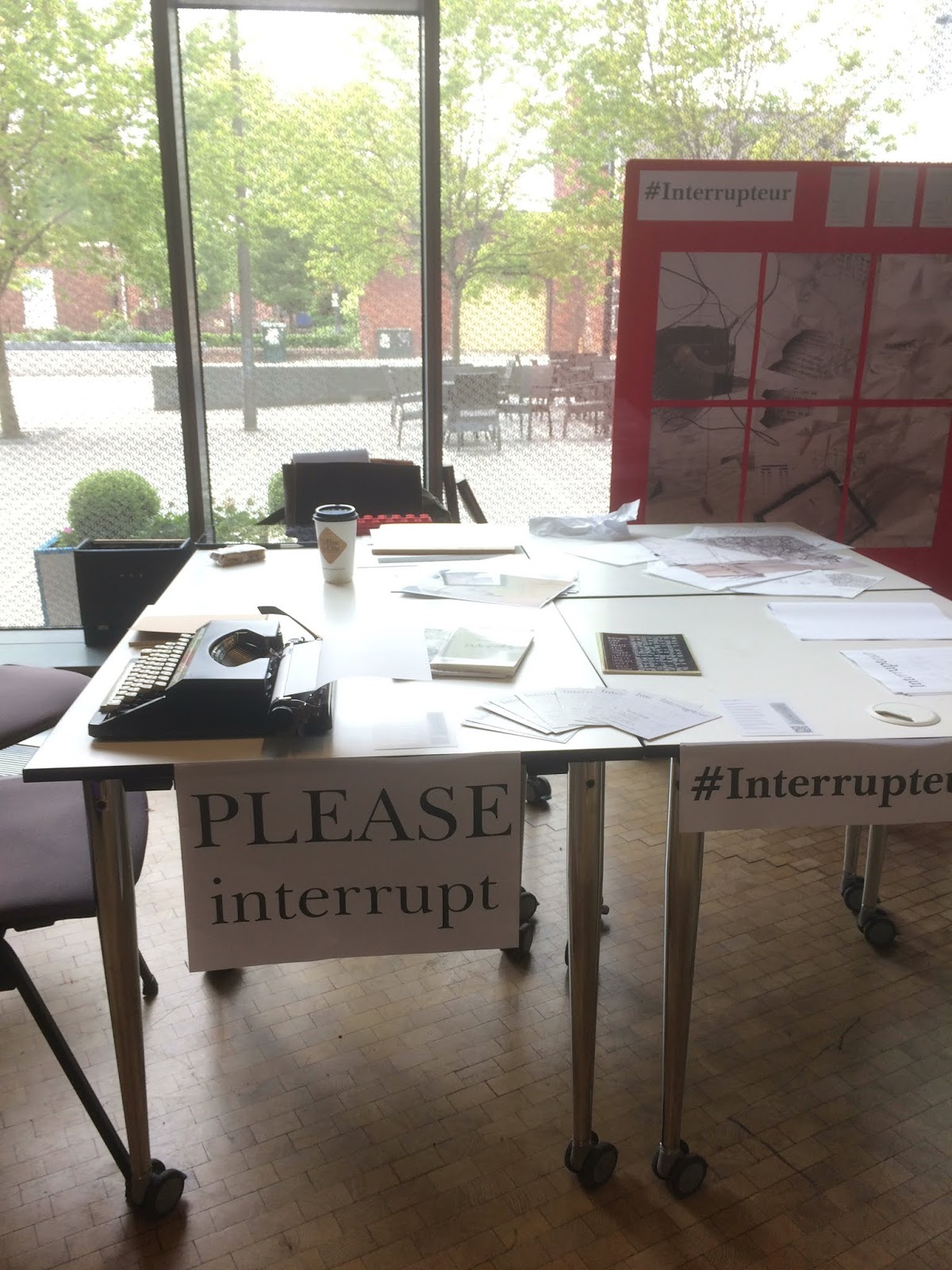
or take a break and sit at the typewriter a while - it remains here after a successful day yesterday


Tuesday, 24 April 2018

Error and reflection


In the act of typing I am experiencing error with repeated frustration.

This leads me to consider my own relation with the laptop keyboard and the more gentle approach it seems to require by comparison. 

Vilem Flusser explores the act of writing as digging, a penetrating gesture which cuts away rather than constructs, he makes the connection even to the typewriter despite resembling the piano:

The pointed pencil […] reminds us of course much more of the original gesture of scratching than does the typewriter, which reminds us of nothing in our tradition except the piano […] it is evident that to type is still to ‘impress’, namely a gesture that presses into a surface, although in fact it presses ink onto a surface. Its intention is one of digging.


But I am aware of how little the laptop keys impact or press on either the paper or my own body. 

Except perhaps the bodily cramp which comes from being unaware of how long I have been sat writing and staring at the screen for. The gritty dry eye is by far my biggest physical discomfort.


Today people have come back to comment on how their fingers are still vibrating even after finishing a short burst of typing.

The typewriter has been a revealing object which tells something of peoples age in their encounter with it. Many have stories to tell of using them, as well as those who have come curious and excited for their first encounter.

The laptop screen seems a portal which links to a wider space, whereas the typewriter focuses attention towards a single letter and is a much more contained activity.

There have been discussions about process. How the thinking process disappears when writing digitally. Marginalia, notes, scribbles, errors and corrections all vanish, leaving little evidence of the effort or editing that has gone into sculpting the final result.

Auto correct and the difficulty of working without a safety net has been apparent today, yet there have also been discussions around the errors which are corrected by the computer unnecessarily, as well as the restrictions which we will accept and work under in our relation with technology and machines.