Events

Showing posts with label typewriters. Show all posts

Tuesday, 22 May 2018

Interruptions on Day Seven


Interruptions aplenty from a range of people and disciplines today.


Conversations about paradigms, the multiplicity of meaning, the need to push fixed ideas around towards matters of concern


Talking and writing haikus, exploring ideas around found language, reading in public spaces and performative acts


Engaged in constraint based processes


Conversations about the productive space of a foyer, the unexpected encounter, how to push our thinking into new spaces 


Historical ghosts, musical hall, performative acts and how our expectations can be challenged or disrupted


Following the constraint, but pushing the rules


 Haikus found in the books of Rachel Smith, typed by Brian Lewis from Longbarrow Press


Thanks to everyone who stopped by today for lot of interesting and productive interruptions
See you tomorrow


There is Freedom in Constraint


Today from 11am Rachel Smith and Helen Frank will be working under a range of constraints as they explore compliance, misrepresentation, and error within any given system.

Helen Frank works within sets of self-imposed mathematically inspired rules. Her particular focus is on the contradictory potential of these artistic constraints. Both hand and mind are players in the system, and so too are the properties of determinism and free will: diligence, disruption, adherence, and errancy. Often the resulting art works are evidence of a slightly absurdist evolution. 


Interruptions around music hall, performance, ghosts, and narrative


Tuesday, 24 April 2018

Error and reflection


In the act of typing I am experiencing error with repeated frustration.

This leads me to consider my own relation with the laptop keyboard and the more gentle approach it seems to require by comparison. 

Vilem Flusser explores the act of writing as digging, a penetrating gesture which cuts away rather than constructs, he makes the connection even to the typewriter despite resembling the piano:

The pointed pencil […] reminds us of course much more of the original gesture of scratching than does the typewriter, which reminds us of nothing in our tradition except the piano […] it is evident that to type is still to ‘impress’, namely a gesture that presses into a surface, although in fact it presses ink onto a surface. Its intention is one of digging.


But I am aware of how little the laptop keys impact or press on either the paper or my own body. 

Except perhaps the bodily cramp which comes from being unaware of how long I have been sat writing and staring at the screen for. The gritty dry eye is by far my biggest physical discomfort.


Today people have come back to comment on how their fingers are still vibrating even after finishing a short burst of typing.

The typewriter has been a revealing object which tells something of peoples age in their encounter with it. Many have stories to tell of using them, as well as those who have come curious and excited for their first encounter.

The laptop screen seems a portal which links to a wider space, whereas the typewriter focuses attention towards a single letter and is a much more contained activity.

There have been discussions about process. How the thinking process disappears when writing digitally. Marginalia, notes, scribbles, errors and corrections all vanish, leaving little evidence of the effort or editing that has gone into sculpting the final result.

Auto correct and the difficulty of working without a safety net has been apparent today, yet there have also been discussions around the errors which are corrected by the computer unnecessarily, as well as the restrictions which we will accept and work under in our relation with technology and machines.


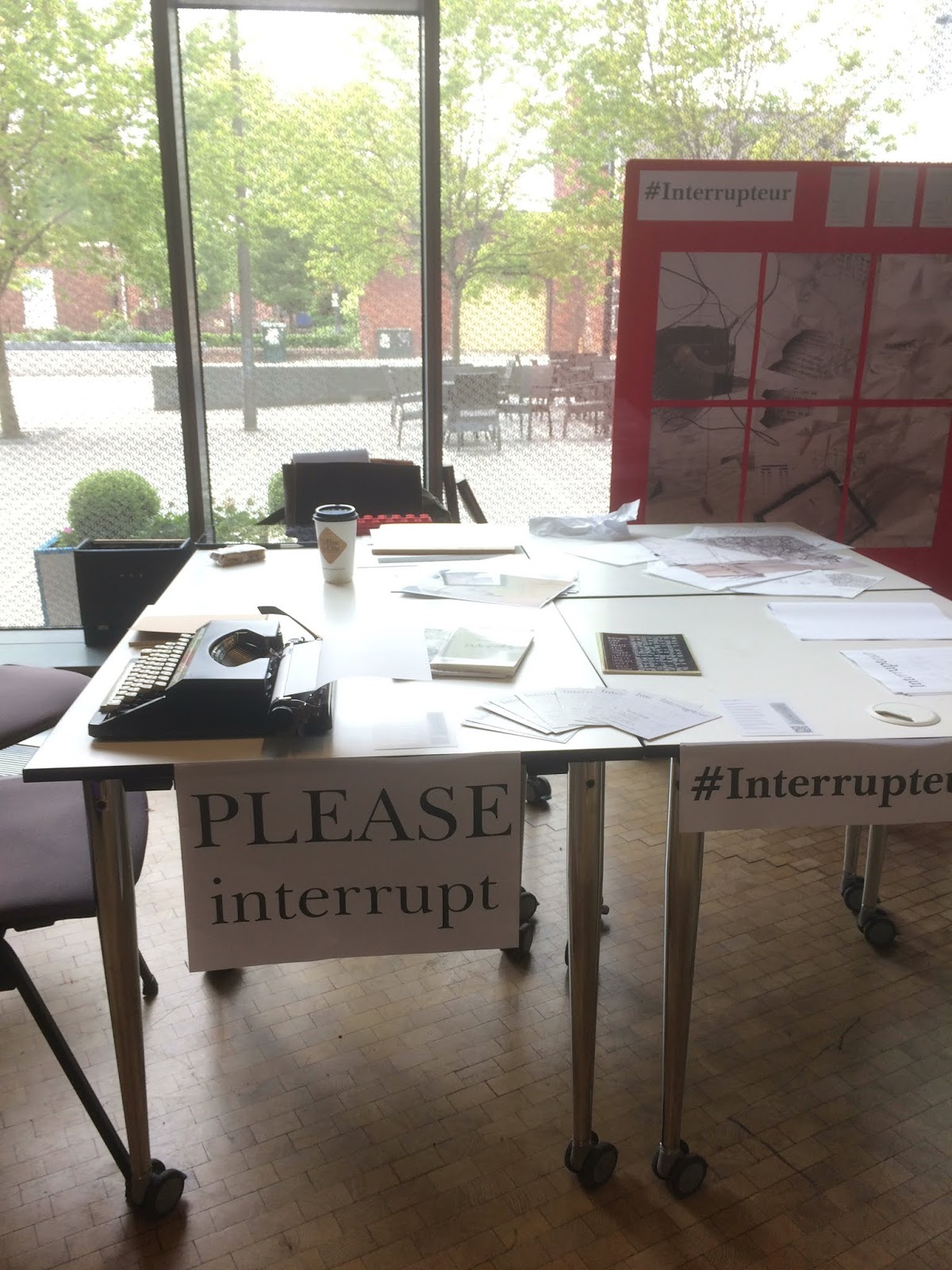


Residency Day 3

More interruptions

The noise of the typewriters is drawing people in....


Come along and try out your skills at writing from before the digital auto correct was invented


copying was an act of reproduction; now it is nominated as an act of creation

Today in Jessop West foyer, artists Rachel Smith and Madeleine Walton are copying, and responding to Bartleby the Scrivener the novella by Herman Melville. 

They are interested in a variety of conceptual writing strategies as well as following the observations of Roland Barthes: 

Has it never happened, as you were reading a book, that you kept stopping as you read, not because you weren't interested, but because you were: because of a flow of ideas, stimuli, associations? In a word, haven't you ever happened to read while looking up from your book? 


While typing the distractions and sounds from the foyer will possibly seep into the typed work


Come along and interrupt 

Become part of the typed distraction in the work, or join in and take your turn with a vintage typewriter